Have you ever stopped to think about how many amazing musical instruments exist in the world? We all know the staples, the Guitar, the Piano, the Violin, but what happens when you start digging into the deeper, global catalogue of sound makers? That’s where the real magic is hidden, often under letters we might overlook. If you are looking for musical instruments that start with N, get ready to expand your playlist because this is one of the most surprising and diverse groups out there.
From the ancient, sacred wind instruments of South India to a complex, keyed fiddle from Sweden, the letter ‘N’ unlocks a treasure chest of sound. This article is your guide, written by a fellow instrument enthusiast, to help you discover the history, sound, and cultural significance of the most notable, interesting, and lesser known musical instruments that start with N. Whether you are a music student, a seasoned musician, or just looking for a unique pub quiz answer, you are in the right place to explore these remarkable instruments.
Notable and Widely Known ‘N’ Instruments
While the letter ‘N’ might not be the most common starting point for popular instruments, the ones that do exist are powerful players in their respective music traditions. They are often the instruments that define the sound of an entire region, mixing history, complexity, and sheer power.
1. The Nyckelharpa (String)
Imagine an instrument that combines the mournful bowed strings of a violin, the mechanism of a hurdy gurdy, and the rich resonance of a cello. You would be describing the Nyckelharpa, a beautiful and complex Swedish keyed fiddle.
- Origin and History: Though the earliest visual evidence of keyed fiddles dates back to 1408 in a fresco in Siena, Italy, the Nyckelharp found its true historical foothold and modern development in Sweden, particularly in the province of Uppland. It has been continuously played for over 600 years, making it one of the oldest European folk instruments still in use.
- Anatomy and Sound: Its name literally means “key harp” (nyckel = key, harpa = stringed instrument). The player uses a short bow with their right hand. The real magic, however, is in the left hand, which presses wooden keys. These keys have small wooden pieces, called tangents, that reach up and press against the strings, changing the pitch. A modern Nyckelharpa often has up to sixteen strings: three melody strings, one drone string, and twelve sympathetic strings that vibrate in harmony to create a shimmering, ethereal resonance.
- Cultural Significance: Today, it is an archetypal symbol of Swedish folk music and culture, celebrated in traditional festivals and folk dance events.
2. The Nadaswaram (Wind)
If you have ever been to a temple festival or a wedding in South India, you have almost certainly heard the glorious, booming sound of the Nadaswaram. It is not just an instrument; it is a sacred, auspicious sound that announces joy and divinity.
- Classification and Power: The Nadaswaram sometimes spelled Nagaswaram is a large, conical, double reed wind instrument. It belongs to the family of Indian classical music instruments known for having a strong, deep sound. It is widely acclaimed as one of the loudest non brass acoustic instruments in the world, which is why it is best enjoyed in large, open spaces like temple courtyards.
- Cultural Significance: In the Carnatic music tradition of South India, the Nadaswaram is revered as a Mangala Vadya (auspicious instrument). Its presence is considered essential at Hindu weddings and temple ceremonies to invite good fortune and divine blessings.
- Technique: Mastering the instrument requires immense breath control, including the technique of circular breathing, which allows the musician to maintain a continuous sound without interruption. It is played alongside the Thavil, a barrel shaped drum.
3. The Naqqāra (Percussion)
For an instrument with military and ceremonial might, we turn to the Naqqāra. This name refers to a family of small kettledrums played across the Middle East, Central Asia, and India.
- Origin and History: The term Naqqāra comes from the Arabic verb naqr, meaning “to strike or beat.” These drums have a long, storied history, most famously as part of the massive Mehter (Janissary) military bands of the Ottoman Empire. They were essential for signaling, maintaining battle rhythm, and signifying the power of the ruler.
- Description: The Naqqāra typically consists of a pair of small, bowl shaped kettledrums. The rounded part is often made of baked clay, metal, or wood, covered with a stretched skin head. They are played with small sticks and are usually tuned to different pitches: a lower sounding drum called bam and a higher sounding one called zil
- Legacy: The Naqqāra is widely considered the direct ancestor of the modern European timpani or orchestral kettledrum, demonstrating its profound influence on Western music.
Traditional and World Instruments That Start With N
The power of the letter ‘N’ truly shines in the realm of world music, where it names instruments that are integral to specific ethnic and regional folk traditions. These instruments are fascinating examples of cultural craft and musical heritage.
1. The Ney (Wind/Flute)
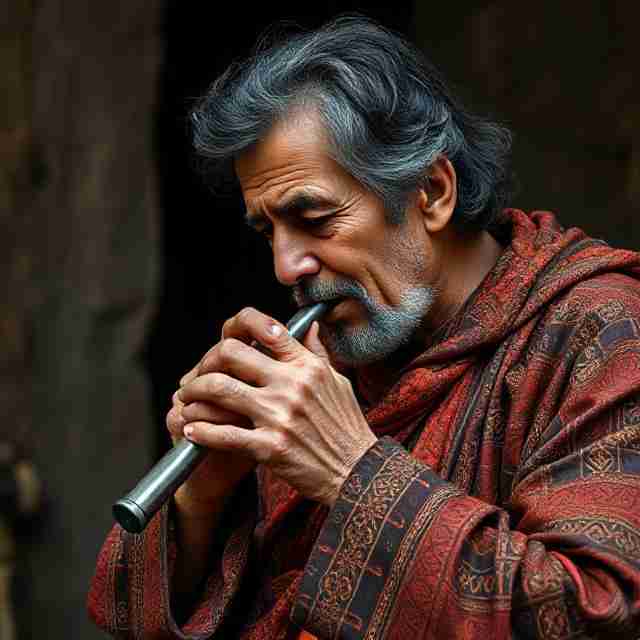
The Ney is an ancient, revered instrument found throughout the Middle East, Central Asia, and parts of North Africa, especially in Persian, Turkish, and Arabic music.
- Classification and History: It is an oblique rim blown reed flute, likely one of the oldest pitched instruments known to man, with a history spanning thousands of years.
- Sound and Use: Ney has a distinctively breathy, warm, and often melancholic tone. In Turkey, it is deeply associated with Sufi music, where its sound is used for meditation and spiritual contemplation, representing the soul’s yearning for the divine.
- Construction: The Ney is typically made from a single piece of hollow reed or cane. The player blows across the rim of the top opening, using a specific lip and breath technique to generate the sound. It has five to six finger holes in front and one thumb hole in the back.
2. The Native American Flute (Wind)
This is one of the most uniquely designed wind instruments in the world, central to the spiritual and social life of many indigenous North American tribes.
- Anatomy: The Native American Flute is an end blown block flute distinguished by having two air chambers. The first chamber collects the player’s breath, and the second chamber is where the sound is actually created. This clever design helps the player achieve a pure, clear tone.
- Sound and Purpose: Its sound is gentle, reflective, and deeply resonant. Traditionally, it was used not for large performances, but for courtship rituals, healing ceremonies, meditation, and personal expression, making its role deeply intimate and spiritual.
3. The Ngoni (String/Lute)
Traveling to West Africa, we encounter the Ngoni a fascinating precursor to the banjo. It is a vital instrument in the musical landscape of Mali, Senegal, and other countries in the region.
- Classification: The Ngoni is a small, traditional four stringed lute.
- Construction: It features a teardrop shaped body, which is traditionally a hollowed out calabash gourd or a wooden resonator covered with a stretched animal skin head, usually goat skin.
- Role in Music: The Ngoni is known for its quick, percussive sound, often played in conjunction with singing or storytelling by professional musicians known as griots. These griots are the keepers of historical, cultural, and musical knowledge, and the Ngoni is their primary tool for performance.
4. The Northumbrian Smallpipes(Wind/Bagpipe)

Not all bagpipes are loud and battlefield ready. The Northumbrian Smallpipes offer a sophisticated, quieter alternative from the North East of England.
- Classification and Sound: Unlike the well known Scottish Great Highland Bagpipe, this instrument is bellows blown, not mouth blown. This allows the player to talk or sing while playing and keeps the air drier, resulting in a sweeter, more stable tone. It is also a closed end chanter pipe, meaning the melody stops when all holes are covered, allowing the player to use staccato notes that the louder pipes cannot achieve.
- Use: Because of its mellow and quiet sound, it is traditionally an indoor instrument, perfect for parlor music, dancing, and small gatherings.
5. The Nohkan (Wind/Flute)
This is a high pitched, delicate transverse flute deeply embedded in the traditional arts of Japan.
- Cultural Context: The Nohkan is specifically used in Noh and Kabuki theatre, two of Japan’s most ancient and revered dramatic art forms.
- Unique Design: It is a small bamboo flute, but its construction is unique: it contains a small, thin piece of bamboo or paper wrapped material placed between the mouthpiece and the first finger hole. This creates a slightly distorted, piercing quality that is instantly recognizable and perfectly suited for the dramatic atmosphere of Noh plays.
Rare, Regional, and Fascinating Instruments That Start With N
As we delve deeper, we discover instruments that are hyper localized, variations on a theme, or classified by a specific part or material. These low hanging related keywords are often what enrich a musical instrument article for a true enthusiast.
1. The Ndingidi (String/Fiddle)
A simple but profound one stringed tube fiddle originating from the Buganda region of Uganda.
- Description: The instrument uses a wooden or bamboo tube as its resonator, with the single string made from vegetal material or metal wire. It is played with a bow and is essential to various forms of Ugandan folk music.
- Sound: The simple construction produces a high pitched, often nasal sound that is vital in rhythmic ensembles.
2. The Nagado Daiko (Percussion)

While many drums exist globally, the Nagado Daiko is a specific and highly recognizable Japanese instrument.
- Classification: This is a long bodied drum from Japan. It is a type of Taiko drum, and its name literally means “long body drum.” It is also known as Miya Daiko (shrine drum) because of its traditional use in temples and shrines.
- Sound and Use: The Nagado Daiko is played with thick sticks called bachi. It is a powerful, deep sounding instrument that provides the thundering foundation for Taiko ensembles and traditional Japanese festivals.
3. The Nanga (String/Harp)
The Nanga is a beautiful example of a harp from Uganda and the Central African region.
Classification: It is a small, seven stringed rectangular box harp or arched harp.
- Cultural Context: Nanga musicians are highly respected, often performing at royal courts and important ceremonies. The sound box is covered with animal skin, and the strings are traditionally made of gut or vegetable fibre, creating a delicate, resonant plucking sound.
4. The Ney Anban (Wind/Bagpipe)
This is a unique form of bagpipe from the southern coastal regions of Iran.81
- Construction: The Ney Anban features a bag made of goat skin, which holds the air, and two double reed pipes, the Ney (flute) and the Anban (bag).
- Sound: Unlike the Ney flute, the bagpipe version has a louder, more sustained sound, making it perfect for festive occasions, dances, and celebratory music in its native regions.
5. The Nao (Percussion)
Sometimes, the simplest instruments are the most necessary. The Nao refers to a pair of large cymbals from China.
- Use: Nao cymbals are essential in Chinese opera, martial arts, and various traditional ensembles, where they provide bright, percussive accents and rhythmic punctuation.
Comparing Key Musical Instruments That Start With N
To help organize and summarize this fascinating collection of musical instruments that start with N, here is a custom fact sheet comparing the most significant examples. This table highlights their classification, origin, and distinguishing characteristics, making it an excellent resource for quick comparison and citation.
| Instrument Name | Classification | Primary Origin | Distinguishing Feature | Sound Character |
| Nyckelharpa | Bowed String/Chordophone | Sweden | Key-actuated tangents fret the strings. | Ethereal, resonant, fiddle like. |
| Nadaswaram | Double Reed Wind | South India | World’s loudest non brass acoustic instrument. | Powerful, piercing, auspicious. |
| Naqqāra | Kettledrum/Membranophone | Middle East, Persia | Small, paired kettledrums (precursor to timpani). | Sharp, percussive, military/ceremonial. |
| Ney | Oblique Rim Blown Flute | Middle East, Turkey, Iran | Blown across the rim; extremely ancient. | Breath-filled, melancholic, spiritual. |
| Ngoni | Lute/String | West Africa (Mali) | Gourd or wooden body with stretched skin head. | Plucky, rhythmic, precursor to the banjo. |
| Nohkan | Transverse Flute | Japan | Contains a fixed internal piece for a unique tone. | High pitched, slightly distorted, theatrical. |
| Native American Flute | End Blown Block Flute | North America | Two air chambers (mouthpiece and sound chamber). | Gentle, reflective, intimate. |
The Sound of Innovation: Modern N-Classifications
While the core of our exploration focuses on traditional musical instruments that start with N, the letter also appears in the modern lexicon of music technology and design, often signifying an innovative approach to an established instrument.
1. Nylon String Guitar
This is less a single instrument and more a crucial classification, but the term is essential to guitarists worldwide. The Nylon String Guitar is most famously embodied by the Classical Guitar.
- Difference: Unlike the steel string guitar, the Nylon String Guitar uses three nylon strings for the bass and three monofilament nylon strings for the treble.
- Sound and Use: This choice of string creates a softer, mellower, and warmer tone. It is the definitive instrument for classical music, flamenco, and bossa nova, demanding a different, more delicate playing technique than its steel string cousin.
2. Natural Trumpet
This is a historical classification that remains significant in the world of early music performance. The Natural Trumpet refers to any trumpet without the valves we are accustomed to today.
- Historical Context: Before the invention of valves in the early nineteenth century, trumpeters had to rely entirely on varying their lip tension (embouchure) to produce the limited notes available in the harmonic series.
- Significance: The Natural Trumpet was widely used in European court music and military signaling from the fifteenth century onward, representing the original sound of the trumpet heard in the works of Baroque masters like Bach and Handel.
Final Thought
What a journey! From the thundering war cries of the Naqqāra to the gentle, spiritual notes of the Native American Flute and the intricate folk melodies of the Nyckelharpa, the world of musical instruments that start with N is proof that diversity is the music world’s greatest strength.
It is easy to stick to the well traveled musical paths, but every single letter of the alphabet, and certainly ‘N’, holds untold cultural histories and surprising sounds just waiting to be heard. I encourage you to take the next step: don’t just read these names, find videos or recordings of these instruments. The moment you hear the haunting depth of the Ney or the celebratory blast of the Nadaswaram , you will gain a deeper appreciation for the endless creativity of human culture.
If you enjoyed reading this article, explore musical instruments that start with O for more information on the lexicon of musical instruments.
About the Author